
TL;DR
AI Agents in Business are software systems that can plan, decide, and complete tasks on their own. In 2026, companies are using them in customer support, sales, marketing, HR, finance, and cybersecurity to reduce costs and move faster without hiring massive teams.
They’re not just chatbots.
They’re closer to digital coworkers.
And yes they’re already reshaping how companies operate.
Table of Contents
What Are AI Agents in Business?
AI agents in business are autonomous software systems that complete tasks, make decisions, and optimize workflows with minimal human involvement. Instead of waiting for step-by-step instructions, they’re given a goal and they figure out the steps.
Think of them like a really competent assistant. You don’t tell them every click to make. You say, “Resolve this issue” or “Qualify these leads,” and they handle the process.
👉 New to AI agents? Start here: [AI Agents for Beginners: What They Are & How They Work]
Why Businesses Are Rapidly Adopting AI Agents in 2026
Let’s be honest. Businesses are under pressure.
Operating costs are rising. Skilled talent is harder to hire. Customers expect instant responses. And global competition doesn’t sleep.
AI agents are filling the gap.
Rising Costs Are Forcing Smarter Automation
Hiring isn’t cheap. Salaries, benefits, training, management overhead it adds up fast.
In high-volume environments like customer support or back-office processing, companies report significant cost reductions after implementing AI agents sometimes 30–60%, depending on scope and automation depth.
That’s not small optimization.
That’s structural change.
Talent Shortages Are Real
Good sales reps. Skilled cybersecurity analysts. Experienced finance teams.
They’re expensive and limited.
AI agents don’t replace them outright. But they remove repetitive workload so human teams can focus on judgment-heavy work instead of clicking through dashboards all day.
24/7 Markets Demand 24/7 Systems
Customers in different time zones expect immediate responses. Waiting 12 hours for an email reply feels outdated now.
AI agents don’t care what time it is.
They respond instantly whether it’s 2 PM or 2 AM.
Personalization at Scale Is Impossible Manually
Modern customers expect personalized emails, recommendations, and fast support.
Humans simply can’t personalize millions of interactions daily.
AI agents can analyze behavior patterns and tailor responses automatically. That’s one of the biggest reasons enterprise AI agents are becoming core infrastructure in 2026.
How AI Agents Are Different From Traditional Automation
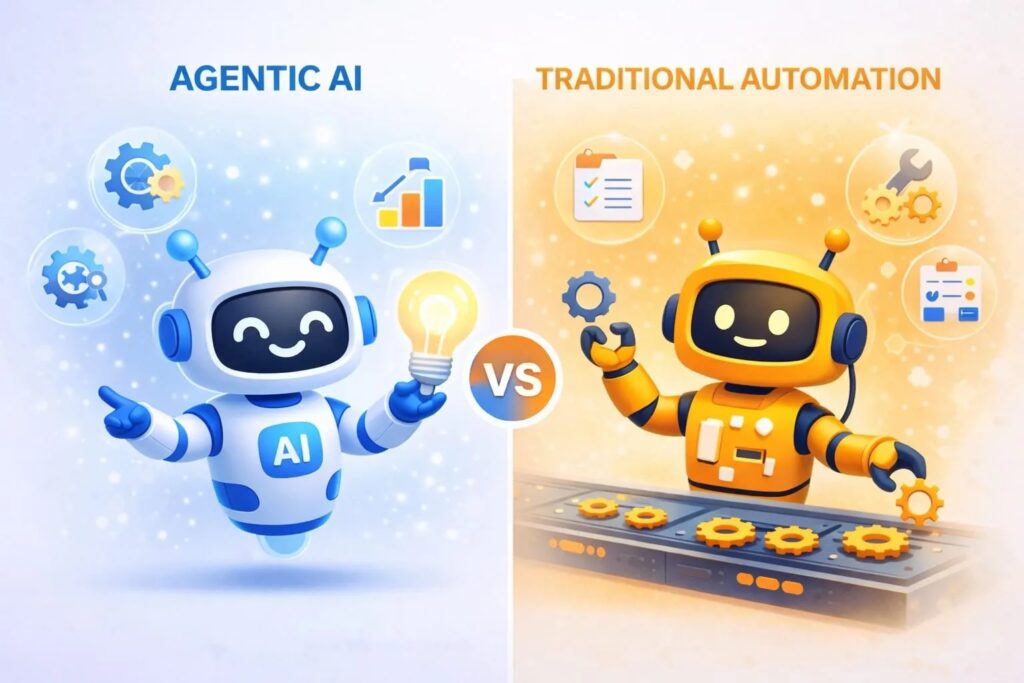
Not all automation is intelligent.
Traditional automation follows fixed rules. If X happens, do Y.
AI agents are different.
Instead of rigid instructions, they operate around goals.
Old automation is like a vending machine.
You press a button. It gives you exactly one snack.
AI agents are more like a capable assistant.
You give them an objective and they decide the sequence of actions needed to reach it.
If you want a deeper comparison, this breakdown helps:
👉 [AI Agents vs Chatbots: What’s the Real Difference?]
Real-World AI Agents Use Cases
This is where things get practical.
Let’s talk about how businesses actually use AI agents not in theory, but in daily operations.
AI Agents in Customer Support
Customer support is one of the fastest-growing AI agents use cases.
Imagine an online store receiving 10,000 tickets per week.
Instead of building a 25-person support team, companies now deploy AI agents that:
- Read and understand the issue
- Check order history
- Trigger refunds or exchanges
- Send tracking updates
- Escalate only complex cases
In some high-volume environments, automated first-line resolution can reduce per-interaction costs dramatically sometimes under a dollar when fully automated.
More importantly, response time drops from hours to seconds.
That shift alone changes customer experience.
Sales & Lead Qualification Agents
Sales teams lose time chasing leads that were never serious.
AI agents now analyze inbound forms, behavior patterns, and engagement data to score leads automatically. They can schedule meetings, draft follow-up emails, and update CRM systems without human input.
It’s like having a digital sales assistant that never forgets to follow up.
For startups especially, AI agents for startups can reduce the need for a large SDR team in early stages. I’ve seen small teams double their outreach capacity without doubling headcount.
That’s leverage.
Marketing & Content Optimization
Marketing is chaotic.
Ads, email campaigns, SEO updates, analytics dashboards it’s constant.
AI agents monitor campaign performance in real time. If a campaign underperforms, the system can adjust budgets or test new variations automatically.
Instead of manually refreshing SEO articles every few months, AI agents can flag outdated stats, suggest improvements, and even draft updates.
If you’re exploring this side of automation, this guide connects well here:
👉 [Benefits of AI Agents for Modern Businesses]
AI Agents in HR & Recruitment
Hiring can consume entire weeks.
AI agents now screen resumes, rank candidates based on job descriptions, and schedule interviews automatically.
Picture receiving 1,000 applications.
An AI agent narrows that to 50 strong matches in minutes.
That said this is where governance matters. AI systems can reflect biases in data. Smart companies use AI as a filter, not a final decision-maker.
Human oversight isn’t optional.
AI Agents in Finance & Operations
Finance teams deal with repetitive but sensitive workflows.
Invoice processing. Fraud detection. Expense audits. Budget forecasting.
AI agents in finance scan transaction patterns, flag anomalies, and generate reports faster than manual systems.
If something unusual happens like abnormal spending the system alerts teams instantly instead of waiting for monthly review.
Speed equals protection.
IT & Cybersecurity AI Agents
Cybersecurity is a race against time.
AI agents monitor systems continuously, detect unusual behavior, isolate threats, and even deploy patches automatically.
Even shaving minutes off response time can significantly reduce damage during a breach.
Enterprise AI agent platforms are investing heavily in this area because automation here isn’t optional anymore it’s survival.
Industries Leading Adoption
Some industries are moving faster than others.
E-commerce leads because of ticket volume and transaction data.
SaaS companies adopt early because integration is easier in cloud-native systems.
Banking and fintech use AI agents heavily in fraud detection and compliance monitoring.
Healthcare is accelerating administrative automation, even if clinical decisions still require doctors.
Logistics companies use AI agents to reroute shipments in real time based on weather and traffic data.
Consulting firms are using them internally to analyze client datasets and simulate strategy models.
It’s not hype. It’s infrastructure.
What Benefits Are Companies Actually Seeing?
Across industries, the reported benefits are consistent:
- Significant operational cost reduction in repetitive workflows
- Faster internal decision-making
- Better scalability without proportional hiring
- Fewer human errors in data-heavy tasks
- Improved customer response times
A mid-sized retailer that automated support and finance operations saw measurable shifts within six months. Support resolution times dropped from days to minutes. Manual refund backlogs disappeared. Employee satisfaction increased because repetitive tasks were eliminated.
That’s not magic.
It’s focused automation applied strategically.
What Are The Risks Of AI Agents In Businesses?
AI agents aren’t flawless.
Data privacy issues. Security vulnerabilities. Hallucinations. Integration challenges.
If an AI system makes a mistake in finance or healthcare, consequences can be serious.
That’s why successful implementation includes monitoring, auditing, and fallback systems.
Businesses shouldn’t treat AI agents as invisible background tools.
They’re digital workers.
They need supervision.
Build vs Buy: What’s Smarter?
Some companies build AI agents in-house for full control and customization.
Others use enterprise AI agent platforms for faster deployment and lower upfront cost.
In reality, many businesses combine both using existing platforms while building custom layers on top.
The right choice depends on budget, expertise, and long-term strategy.
If you want to understand the technical mechanics behind these systems, this deep dive helps:
👉 [How AI Agents Work: A Simple Breakdown]
How to Start Implementing AI Agents?
If you’re running a business and wondering where to begin, start small.
Identify one repetitive, high-cost workflow.
Define measurable outcomes cost savings, response time, accuracy improvements.
Pilot in one department.
Measure ROI.
Then scale gradually.
Trying to automate everything at once usually creates more complexity than value.
What Is The Future of AI Agents in Business? (2026–2030)

We’re heading toward multi-agent systems where different AI agents collaborate.
Marketing agents talking to sales agents.
Finance agents syncing with procurement agents.
We’ll likely see vertical-specific AI agents tailored for healthcare, law, logistics, and retail.
Some companies may run entire operational layers powered primarily by AI systems.
Humans won’t disappear.
But their role will shift toward oversight, creativity, and strategic thinking.
FAQs
What are AI agents in business?
AI agents in business are autonomous software systems that complete tasks and make decisions with minimal human input. They are commonly used in customer support, sales, HR, finance, and cybersecurity to improve efficiency and reduce repetitive workload.
How are companies using AI agents?
Companies use AI agents to resolve support tickets, qualify sales leads, monitor campaigns, screen resumes, detect fraud, and monitor IT systems. These AI agents use cases help automate routine processes while improving speed and scalability.
Are AI agents replacing employees?
In most cases, AI agents augment employees rather than replace them. They handle repetitive or data-heavy tasks so human teams can focus on strategic, creative, and relationship-driven work.
Conclusion
AI agents in business are no longer experimental.
They’re becoming operational infrastructure.
From customer support to cybersecurity, enterprise AI agents are reshaping how companies operate in 2026.
The businesses that adopt thoughtfully not blindly will gain efficiency without losing control.
And that balance is where the real advantage lives.





Leave a Comment