
Chatbots are built to have conversations they respond to what you say and stop when you stop talking. AI agents are built to get things done they work toward goals, take actions across systems, and keep running without you prompting them every step. The line between them is blurring fast in 2026, but the core difference still matters when you’re deciding which one to use.
Table of Contents
AI Agents vs Chatbots
If you’ve used a customer service bot recently and thought “this feels more intelligent than it used to,” you’re not imagining things.
Modern chatbots have gotten significantly smarter. They don’t just follow scripts anymore they understand context, handle follow-up questions, and in many cases, they’re now connecting to external systems to check your order status, reset your password, or update your account details.
So when someone says “chatbots can’t do what AI agents do,” that’s… not entirely accurate anymore. The honest answer is more nuanced than most comparison articles admit.
That said, there’s still a meaningful difference and understanding it will help you make smarter decisions about which technology actually fits your situation.
What Actually Is A Chatbot?
A chatbot is software designed for conversation. You send a message, it responds. Simple as that. learn more about AI Chatbots in (What is AI)
The earliest chatbots were purely rule-based essentially decision trees disguised as conversation. You’d type “track my order,” it would recognize that phrase, and reply with a scripted response. They were useful but brittle. Say something they didn’t expect, and they’d fall apart.
Modern chatbots are a different story. Powered by large language models, they can handle messy, unpredictable conversations, understand intent even when phrasing is unusual, and give genuinely helpful responses across a wide range of topics. Some can now call APIs, check databases, and take limited actions things that used to be exclusive to agents.
But here’s the key thing about chatbots, even the smart ones: they’re fundamentally reactive. The conversation starts when you start it. It ends when you end it. The bot isn’t doing anything when you’re not there.
Think of a chatbot like a knowledgeable receptionist. Ask them a question, get an answer. Walk away, and they’re waiting for the next person to walk in.
What an AI Agent Actually Is?
An AI agent is built around a different idea entirely instead of responding to you, it works toward a goal.
You give it an objective (“monitor my inbox and follow up with anyone who hasn’t replied to a proposal after 3 days”), and it handles the execution independently. It observes information, decides what action to take, executes that action, checks the result, and repeats often without you touching it again.
The critical difference isn’t intelligence. It’s autonomy and continuity.
An AI agent doesn’t wait for you to ask. It’s running in the background, doing things, making decisions, interacting with other systems whether you’re at your desk or asleep.
If a chatbot is a receptionist, an AI agent is more like an employee who has a job to do, knows how to do it, and gets on with it without being managed every step of the way.
For a deeper look at how agents work under the hood, this breakdown covers the full decision-making cycle: [How Do AI Agents Work? Step-by-Step Explanation]
The Core Difference And Why It’s Getting Complicated
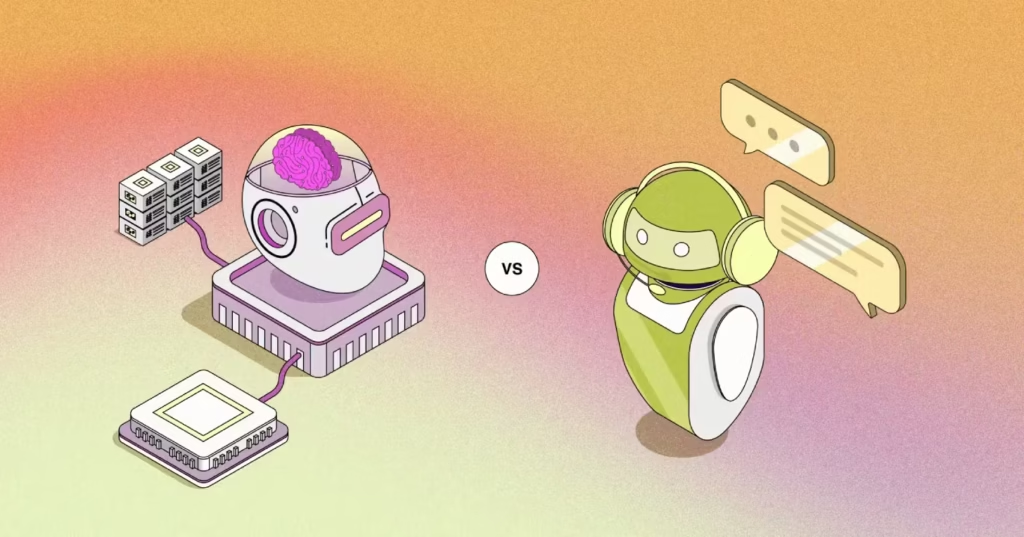
The traditional way to explain this was clean and simple: chatbots talk, agents act.
That’s still mostly true, but the edges are getting fuzzy.
Modern chatbots especially those built on platforms like GPT-4 or Claude can now browse the web, run code, call APIs, and take multi-step actions within a conversation. Some of that looks a lot like agentic behavior.
And many AI agents have chat interfaces, making them look and feel like chatbots from the user’s perspective.
So what actually separates them in 2026?
The real distinction isn’t about whether a tool uses APIs or handles multiple steps. It’s about autonomy level specifically, whether the system needs you to drive every interaction or whether it operates independently toward goals you’ve set.
A chatbot with tool access is still waiting for you to ask before it does anything. An AI agent with a chat interface is still running jobs in the background whether you’re talking to it or not.
That’s the line that actually matters.
Side-by-Side: Where They Differ
| Feature | Chatbots | AI Agents |
|---|---|---|
| Core purpose | Have conversations | Complete tasks autonomously |
| Behavior | Reactive (responds when prompted) | Proactive (works toward goals) |
| Runs continuously | No | Yes |
| Multi-step tasks | Limited | Core capability |
| Autonomy level | Low | High |
| Best for | Customer Q&A, simple support | Automation, workflows, monitoring |
One thing worth noting: the “uses external tools” row that most comparison articles include is no longer a useful differentiator. Almost everything uses external tools now. What matters is how much independence the system has in deciding what to do next.
Three Examples That Make It Obvious
Customer support: A chatbot answers a customer’s question about your return policy. The customer asks for a refund the chatbot provides instructions and maybe escalates to a human.
An AI agent handles the whole thing. It verifies the purchase, initiates the refund, updates your inventory system, sends a confirmation email, and logs the interaction in your CRM. The customer never waits for a human.
Scheduling: A chatbot tells you what times are available and asks you to confirm.
An AI agent checks both parties’ calendars, proposes options, handles the back-and-forth, books the meeting, sends calendar invites, and adds a video link triggered by a single email saying “let’s find a time to meet.”
Monitoring: A chatbot can tell you the current price of something if you ask.
An AI agent watches the price continuously, notices when it drops below your target, and either alerts you or makes the purchase depending on what you’ve authorized it to do.
The pattern is consistent: chatbots give you information, agents take action.
Which One Do You Actually Need?
This depends less on the technology and more on what problem you’re solving.
A chatbot makes sense when your main goal is answering questions customer support FAQs, basic information retrieval, guiding users through a process with conversation. They’re simpler to set up, easier to control, and often cheaper to run for this specific purpose.
An AI agent makes sense when you want something done, not just explained. If you’re tired of doing the same tasks repeatedly, need something monitored around the clock, or want to automate a workflow that spans multiple tools and systems that’s where agents earn their place.
The honest answer for most small businesses and individuals? Start with a chatbot for customer-facing interactions where conversation is the point. Add AI agents behind the scenes for operations and automation where you need execution, not explanation.
They complement each other better than they compete.
For practical examples of agents handling real workflows, [Real-Life AI Agent Examples & Use Cases] covers a wide range of industries and use cases.
The Bottom Line
Chatbots and AI agents aren’t really competing for the same job. Chatbots are conversation tools they’re there when customers or users need to interact with something. Agents are execution tools they handle work that would otherwise pile up in your to-do list.
The confusion comes from the fact that both are getting more capable, and the boundaries between them are genuinely blurring. But at their core, the distinction holds: one waits for you to talk to it, the other works while you’re not looking.
If you’re evaluating options for your business or your own workflow, the question to ask isn’t (AI Agents vs Chatbots) it’s “do I need better conversations or better automation?” The answer usually points pretty clearly in one direction.
Is ChatGPT a chatbot or an AI agent?
ChatGPT started as a chatbot a conversational tool you interact with through prompts. But as of 2025–2026, it’s evolved. With tools like browsing, code execution, and memory, modern versions can exhibit agentic behavior within a session. That said, it still requires you to initiate and guide each conversation, which keeps it closer to the chatbot end of the spectrum for most use cases.
Can chatbots become AI agents?
In some ways, yes. Modern chatbots built on powerful language models can now call APIs, execute multi-step tasks, and take actions within conversations. The gap is narrowing. But a chatbot with extra capabilities is still fundamentally reactive it needs you to start the process. A true AI agent runs autonomously toward goals without constant prompting. The architecture and intent are different, even when the capabilities overlap.
Are AI agents more expensive than chatbots?
This used to be a clear yes, but it’s changing fast. The rise of smaller, more efficient language models has significantly reduced the cost of running autonomous agents. Cost is no longer the main barrier reliability and trust are. Many no-code agent platforms are now affordable for small businesses and individuals. For straightforward use cases, the price difference between a smart chatbot and a basic agent is smaller than most people expect.
Leave a Comment